

By Fred Gibbs
Just to be clear, the opinions and statements made within my articles are strictly mine and may not necessarily reflect any policy or position of the Arizona Pilots Association.
ENGINE FAILURES
A couple of years ago, the General Aviation Joint Steering Committee, the FAA, airframe manufacturers, user groups, associations and other parties joint together in developing ways to mitigate the threat of engine failures as a fatal accident cause. Ironically, recommendations from that effort are still emerging, but I believe that most engine failures are not mechanical in nature but are pilot-related.
That’s not to say sometimes things just break for no apparent reason. But more often than anyone wants to admit, it appears carburetor ice—which conveniently disappears by the time investigators arrive—is an unidentified co-conspirator, unless the aircraft was fuel-injected. I’d also lump in fuel mismanagement and just plain old failure to properly operate the engine. All that said, it’s of little comfort when an engine quits and you didn’t do anything wrong. While the same is true for system failures, they’re much less frequent here and certainly less lethal.

None of which really matters when you can’t continue the flight and need a decent landing area. Mitigations for engine/systems failures aren’t as sexy or tangible as for other defining events, but they are obvious. Perhaps the most bang for the buck is a strict maintenance regimen: Don’t skimp on inspections, oil analysis or manufacturer’s recommended operating procedures and lubricants. Operate the engine(s) like a finely tuned instrument, always with loving care and a delicate hand. Remember, your engine(s) is/are hard-working, tempermental assets containing a bunch of moving parts keeping you in the air.
When it comes to maintenance decisions, err on the side of caution. Hoping that one soft (low compression) cylinder will make it to TBO isn’t a safety-oriented strategy. Good risk management is in the eye of the beholder, i.e., YOU, the pilot. You could plan your flight to avoid terrain inhospitable to emergency landings, or fly the risky ones high and in daylight. Use the new tools available on EFBs and in your panel to ensure you’re always close to land or an adequate airport.
And practice engine-out procedures at every opportunity. When your engine quits is not the time to look up the best-glide speed or the off-airport landing checklist. If you fly a twin, regularly plan some dual on one-engine inoperative flight, shoot some approaches with one turning and one burning, and make full-stop landings from them. Remember, the likelihood of a typical light twin successfully going around from a balked landing or missed approach is slim. If you remember last months article, even the single 600shp turboprop engine of the aircraft did not save the aircraft during a go-around due to the high-torque roll tendency at low airspeed.
Do you really know the best glide speed for your aircraft? PS – It is not just one airspeed!!! Just like Va (Maneuvering speed), it, too, is not just one speed, but that is a story for another day. Some day, just for the fun of it, try practicing engine out from cruising altitude into your home airport. Obviously you would need to coordinate with tower, or constant updates on position and altitudes at a non-towered airport. Again, obviously, DO NOT SHUT THE ENGINE DOWN ! Set the throttle just at idle, set up best angle of attack, and see what what best glide speed is for your airplane, what rate of descent is, and could you really make the airfield. With your engine at idle, run the trim to full nose up. Let your airplane stabilize out, and see what airspeed it settles on. (Hint – it should be very, very close to your best glide speed for your present weight!) If your ForeFlight App shows you your glide distance, see if that actually works, and you need to ball-park figure your glide distance per 1000 feet of altitude. For instance, a C172 has a glide ratio of 10 to 1, which, in simple terms, for every 100 feet of altitude you can glide 1000 feet! Or stated another way, if you are 1000 feet above the ground, you could glide approximately 10,000 feet, or just shy of 2 statute miles or 1 2/3 nautical miles (NM). Punch up “Nearest” on your GPS, look at bearing and distance, compute the amount of altitude available between your altitude to that airport’s elevation, use the glide ratio for your airplane and try it. Another way to really improve your chances should you lose your engine is to practice the Commercial 180 degree accuracy landing. (All commercial pilot candidates have to perform this maneuver on their checkride.) Abeam the 1000-foot marks on the runway, pull the power back to idle, and (try to safely) land on the 1000-foot marks and not more than 200 feet past them, on centerline at the correct landing speed(s). At a non-towered airport, stay very very vigilent and broadcast what you are doing and definitely be prepared to go around if it does not look good!! At a towerered airport, coordinate a close-in simulated engine out approach with the tower, usually asking for the option in case you don’t like what is happening. Most tower’s will try to work with you. Obviously, it is traffic dependent, and you may have to stay very flexible in the pattern. Here in Flag, we often request to do 360’s on downwind for spacing.
FUEL-RELATED
Fuel starvation and mismanagement have well-understood roots: Either the flight ends because there’s no fuel aboard or there’s fuel aboard but it can’t get to the engine(s). Although there certainly are scenarios where mechanical faults or other events typically beyond anyone’s control are culpable, the outcome is the pilot’s fault in the vast majority of these accidents.
Start with a firm understanding of your specific airplane’s fuel system, which may vary considerably from the way it left the factory. Be aware that some engine/airframe combinations return excess fuel from the engine to a tank other than the one selected—the system could be pumping fuel overboard. If the airplane has aftermarket auxiliary tanks, they may be approved for use only in straight-and-level flight, not for takeoffs or landings. Remember that fuel gauges in typical personal airplanes are… well, aspirational. In this modern age, it’s foolhardy to base your fuel burn estimates on analog engine power instruments and a stop watch. Install and learn how to use a fuel-flow meter, many of which can be linked to a GPS—even a portable unit—to provide a wealth of information like time/distance to empty, fuel remaining at destination and even miles per gallon (the latter of which can be discouraging compared to a Prius!).
Finally, if there’s any chance you’ll not arrive at your destination with adequate fuel aboard, stop and get some. It’s Aviation 101. If you find yourself in a bind, use the words “minimum fuel” with ATC and you’ll likely receive priority handling, even if VFR. It might be considered insensitive to say this, but there’s really no excuse for running out of gas. With all that as preamble, it’s important to remember that the NTSB’s list of defining events doesn’t include everything, and tend to put causes into the pre-defined boxes, i.e., Loss of Control, Engine failure, fuel starvation, etc. Many accidents are unique, and almost always have more than one root cause. (Remember the Swiss cheese model?)
I STAND CORRECTED:
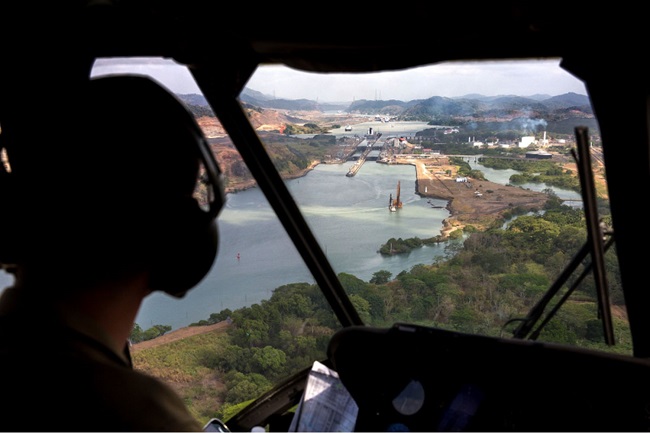
Regarding my comment in last month’s article in the quiz section about “Mean sea level,” I received this input and correction from one of my astute readers, not to the answer, but to my misunderstanding of the actual levels of the oceans as stated here -
“Last time I checked, the Atlantic and the Pacific oceans are not equally level. If they were, why would we need the locks in the Panama Canal to raise and lower the ships passing thru?”
It would be nearly impossible to dig the Panama Canal deep enough to reach seal level. The locks are required to lift the ships to the 85 ft ASL elevation of the main portion of the canal. Also, even if it were dug down to seal level, the extreme tidal surges that would occur through the canal as the two sides tried to “balance” would make navigation nearly impossible (Pacific tides are +/- 11 ft, Atlantic is +/- 1.5 ft). The lakes and locks act as a buffer.
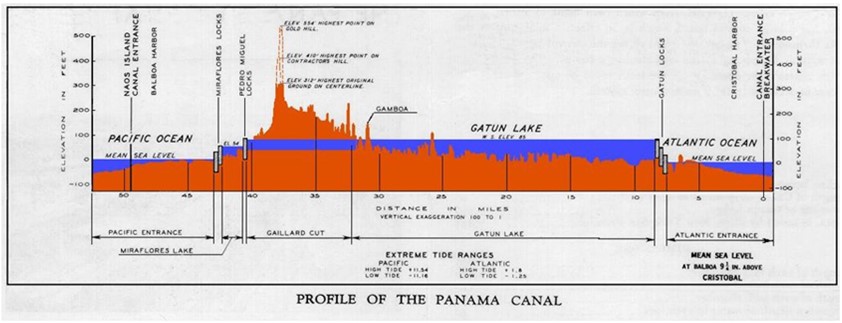
So there you have it! Both oceans are at MSL, the canal is not. I, therefore, stand corrected.
Thanks to Dean DeRosia. In am now smarter than I was last month!!
QUIZ of the MONTH:
- If the air temperature is +8 °C at an elevation of 1,350 feet and a STD lapse rate exists, what will be the approximate freezing level?
- 9,350 feet MSL.
- 3,350 feet MSL.
- 5,350 feet MSL.
- What’s a freezing level?
- What relationship exists between the winds at 2,000 feet above the surface and the surface winds?
- The surface winds tend to veer to the right of the winds at 2,000 feet and are usually weaker.
- The winds at 2,000 feet and the surface winds flow in the same direction, but the surface winds are weaker due to friction.
- The winds at 2,000 feet tend to parallel the isobars while the surface winds cross the isobars at an angle toward lower pressure and are weaker.
- There is no relationship with the altitude difference of 2000 or more feet.
- Unsaturated air flowing upslope will cool at the dry adiabatic lapse rate of approximately –
- 2°C per 1,000 feet.
- 2.5°C per 1,000 feet.
- 3°C per 1,000 feet.
- 4.4°per 1,000 feet
- If you fly into severe turbulence, which flight condition should you attempt to maintain?
- Constant airspeed (VA).
- Level flight attitude.
- Constant altitude and constant airspeed.
- power off, top of the white arc
- The station originating the following weather report has a field elevation of 1,300 feet MSL.
SPECI KOKC 2228Z 28024G36KT 3/4SM BKN008 OVC020 28/23 A3000
A PIREP reports top of the OVC is 3800 feet. How thick is the overcast cloud layer?
- 2,500 feet.
- 500 feet.
- 1,700 feet.
- 700 feet.
(Answers at the bottom of the Safety Program section.)
SAFETY PROGRAMS
FYI, I am pleased to report that there are 2 APA FAASTeam safety programs currently scheduled for the month of May as of right now. They are May 6th in Payson and May 27th in Yuma. More programs are planned over the next couple of months around the state. Simply log on to the Internet and go to WWW.FAASAFETY.GOV, click on “Seminars” and start checking for any other upcoming seminars.
Should you desire a particular safety or educational program at your local airport or pilot meeting in the future, such as the BasicMed program, our “Winter Wonderland” snow season special, ”The Aging Pilot”, Radio Phraseology, or my newest one on LIFR approaches, which discusses the how’s, why’s, and pitfalls of shooting an approach all the way down to minimums and missed approaches, simply contact me at This email address is being protected from spambots. You need JavaScript enabled to view it., or call me at 410-206-3753. Arizona Pilots Association provides the safety programs at no charge. We can also help you organize a program of your choice, and we can recommend programs that your pilot community might really like. There are also a lot of great webinars online, each about an hour long, and worth credits towards your WINGS participation. You might find one that is right up your alley or really “tickles yer fancy”!!
(answers: 1– c 2-c. 3-c. 4- b and 5- b.)