

By Fred Gibbs
Just to be clear, the opinions and statements made within my articles are strictly mine and may not necessarily reflect any policy or position of the Arizona Pilots Association.
AVOIDING ELT FALSE ALERTS
Did you know that Emergency locator transmitters (ELTs) cause over 8,000 false alerts each year in the United States? Yup, that is what they say.
Most of these false alerts occur during testing and maintenance, and they account for 98% of all beacon activations. A false alert is a non-distress activation of an emergency beacon and can be caused by accidental activation during testing, mishandling, improper installation, or unfamiliarity with beacon operation.

False alerts create a problem for Search and Rescue (SAR) personnel, since they respond to every activation of an emergency beacon. SAR response will stop only when the activation has been proven a false alert. Therefore, every false alert has the potential to put rescuers in harm’s way and waste valuable resources.
You should make every effort to prevent or identify false alerts, which will help save time and resources for SAR personnel and allow for a better response to actual emergencies.
It is important for pilots to register their ELTs because the simplest and quickest way for SAR personnel to confirm a false alert is to place a phone call to the person to whom the ELT is registered. They do this using the information provided by the beacon owner in the National Oceanic and Atmospheric Administration (NOAA) Search And Rescue Satellite Aided Tracking (SARSAT) Beacon Registration Database system.
Your ELT can be, and should be, registered through the NOAA via the SARSAT portal. Your contact information should be kept up to date after registration as well.
You should conduct ELT self-tests and annual tests according to the manufacturer’s instructions. If the ELT is accidentally activated, immediately cancel the false alert by calling the U.S. Air Force Rescue Coordination Center at 1-800-851-3051, the U.S. Coast Guard at 1-855-406-USCG (8724), or the nearest Federal Aviation Administration Air Traffic facility and providing the beacon’s hex ID.

VOR DISCONTINUANCE CANDIDATE LIST
The FAA remains committed to the plan to retain an optimized network of VOR NAVAIDs. The Minimum Operational Network (MON) will enable pilots to revert from Performance Based Navigation (PBN) to conventional navigation for approach, terminal and en route operations in the event of a GPS outage and supports the NAS transition from VOR-based routes to a more efficient PBN structure consistent with NextGen goals and the NAS Efficient Streamlined Services Initiative.
The FAA continues to plan the NAS transition from defining ATS routes and instrument procedures using VORs and other conventional NAVAIDs to a point-to-point system based on RNAV and Required Navigation Performance (RNP). RNAV will generally be available throughout the NAS and RNP will be provided where beneficial. The FAA's network of DME NAVAIDs will provide a PBN-capable backup to GPS; however, for aircraft without scanning DME receivers (DD) or DD with Inertial Reference Unit aiding (DDI) equipment, the FAA will provide a conventional navigation backup service based on the proposed VOR MON. The VOR MON is designed to enable aircraft, having lost Global Navigation Satellite System (GNSS) service, to revert to conventional navigation procedures. The FAA has increased the power levels of the remaining low altitude VOR to gaurentee 70-mile reception at or above 5000 feet. The VOR MON is further designed to allow aircraft to proceed to a MON airport where an ILS or VOR approach procedure can be flown without the necessity of GPS, DME, ADF, or Surveillance. Of course, any airport with a suitable instrument approach may be used for landing, but the VOR MON assures that at least one airport will be within 100 NM.
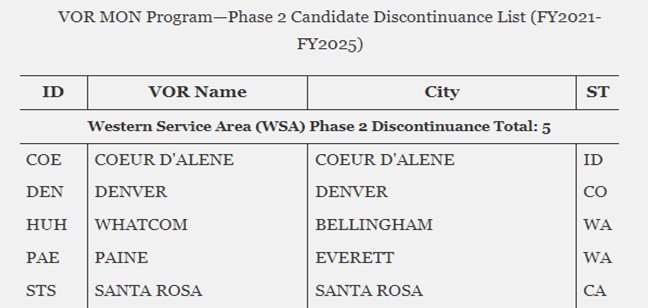
Provided below is a candidate list of VORs being considered for discontinuance in the Western Service Area in Phase 2 (2021-2025) as the FAA works toward the establishment of a VOR MON. It is tentative and may be adjusted based on economic or other factors.
QUIZ of the MONTH:
- Everybody knows what Vx or Vy is, but just what does the “V” mean?
- Vertical climb speed
- Velocity
- Vitesse
- Who cares, I know what the intended meaning is!!
- Consider the following statements regarding a Pilot Weather Report (PIREP),and select which answers are correct:
- A vertical visibility entry does not constitute a ceiling.
- Fog (FG) can be reported only if the visibility is less than 5/8th of a mile.
- The ceiling layer will be designated by a “C”.
- Mist (BR) can only be reported if the visibility is equal to or greater than 5/8th of a statute mile.
- Temperatures reported below zero will be prefixed with a “-“.
- There is no provision to report partial obscurations.
- b, d and f
- b, c and e
- a, b, e and f
- I give up!
- What type of ADS-B equipment is required in class A airspace?
- ADS-B Out that operates on the 1090MHz frequency
- ADS-B Out that operates with UAT on the 978MHz frequency
- Either ADS-B Out on 1090 or the 978MHz frequency
- Either ADS-B Out on 1090 or the 978MHz frequency, but including ADS-B “IN”
- OK, you have just passed your commercial pilot check ride - OOHRAH!! You have been flying on your private ticket with Basic Med. You have been offered a job as a jump pilot for a local skydiving operation. Are you qualified to fly skydivers?
- YES, now that you hold a Commercial certificate
- No, you must first receive a jump pilot endorsement to fly skydivers.
- YES, but you must first receive a jump pilot endorsement to fly skydivers.
- NO, you are not medically qualified.
- The first indication of carburetor icing in an aircraft equipped with a constant-speed propeller would most likely be a
- Decrease in engine RPM
- Decrease in manifold pressure
- Rough running engine followed by loss of RPM
- Can’t get ice with a constant-speed prop
(Answers at the bottom of the Safety Program section.)
SAFETY PROGRAMS
FYI, I am pleased to report that there were 2 APA FAASTeam safety programs held during the month of May. They were May 6th in Payson and May 27th in Yuma. More programs are planned over the next couple of months around the state. Simply log on to the Internet and go to WWW.FAASAFETY.GOV, click on “Seminars” and start checking for any other upcoming seminars.
Should you desire a particular safety or educational program at your local airport or pilot meeting in the future, such as the BasicMed program, our “Winter Wonderland” snow season special, ”The Aging Pilot”, Radio Phraseology, or my newest one on LIFR approaches, which discusses the how’s, why’s, and pitfalls of shooting an approach all the way down to minimums and missed approaches, simply contact me at This email address is being protected from spambots. You need JavaScript enabled to view it., or call me at 410-206-3753. Arizona Pilots Association provides the safety programs at no charge. We can also help you organize a program of your choice, and we can recommend programs that your pilot community might really like. There are also a lot of great webinars online, each about an hour long, and worth credits towards your WINGS participation. You might find one that is right up your alley or really “tickles yer fancy”!!
answers:
1– c Vitesse is the French word for speed
2– a
3– a ADS-B “IN” is NOT required,
4– d Commercial OPS requires an FAA medical, and a BasicMed is NOT an FAA medical, and
5– b Prop governor will make every effort to hold RPM, but manifold pressure will decrease.